Punam Bean · AMFT
Los Angeles · online across California

Category: Uncategorized

  • Pathological demand avoidance in adults: a case study (mine)

    Pathological demand avoidance in adults: a case study (mine)

    Article · PDA · For adults

    Pathological demand avoidance in adults: a case study (mine)

    Pathological demand avoidance (PDA) in adults is an intense, anxiety-linked avoidance of everyday demands, most often described as a profile within autism. Because the word “pathological” frames the person as the problem, some autistic people and clinicians prefer “pervasive drive for autonomy.” This is one late-identified adult’s experience of it, checked against the research that exists, for adults who suspect this might be them and for parents who saw this in their children and then themselves.

    Once upon a time when my marriage and I were young and living in a tiny apartment in New York City, I arranged all the furniture against the wall to maximize space. Every now and then my partner would want to experiment with the layout, maybe pull the sofa away from the wall, or arrange the dinner table diagonally at one end. Even as I recount it now I feel the ABSOLUTELY NOT coming up in my body and chest. I had already thought through all the possibilities, and this arrangement was the one that worked (granted, for me), but I realize now that I was only flexible about things when I didn’t care. That feeling, I now know, is anxiety. The response was what I’ve come to understand as pathological demand avoidance, here expressed as an adult. Looking back, I think what looks like PDA (as it relates to my flavor of autism, specifically) to everybody else is a response to someone questioning the context we’ve built our understanding of the world from. That questioning feels dangerous to the structure we use to navigate the world, even moment to moment.

    No diagnostic manual recognizes PDA as a separate condition (Doyle & Kenny, 2023), and in adults it is barely studied (Kenny & Doyle, 2024). Much of what circulates about it comes from various online communities and social media creators who have reflected on their experiences through a somewhat shared consensus on what it means to be an adult with PDA (Australian Psychological Society, n.d.). This article will describe what PDA as an adult specifically feels like to me — as far as I can surmise. It may or may not match your experience, because we don’t have enough information about PDA in adults to say, “this is it, this is what it means to be PDA.”

    What does pathological demand avoidance in adults feel like?

    This is how I experience my PDA. For me, it’s a constant outrage or avoidance feeling, or a pounding-heart and tingling-hands anxiety response to assumptions made around me where I feel like I’m the only one interrogating the context. I’m offering it here because there is no shared consensus about what it is, exactly. So I’ll do my best to describe how I interpret my experience as it resonates with research and community report, but I expect that not all of this – and sometimes any of this – will resonate with your experience or loved ones.

    When I went to graduate school, I had this counseling class where every week we had to write a journal entry. Every week, our professor would pose a question meant to help us reflect on who we were becoming. The fire hose of information about mental health, relationships, and diagnoses was lifting the veil from our eyes, and every new piece reoriented my perspective. It was a wild time. In my program, I was the only mother of young children in my cohort, and one of two Indian people. In many trainings outside of school I was the only person of color there as a student.

    My encounters with the field of mental health illustrated in so many ways how it left me, and people who looked like me, out. We had trainings on Asian American experiences that didn’t have any Indian people in them. Parenting advice and guidance presumed there was only one child having a meltdown at any given time. White, Western paradigms of the aloof therapist didn’t connect with me, and many of the White men who founded the field built racist and misogynist assumptions into it (American Psychological Association, 2021; Shields, 2016).

    Every professor was so relentless with the gospel of self-care they reminded us almost every day to make sure we had something other than school to fill our lives with. But for me, school was the ultimate vacation. Without a doubt, very often we were asked to submit a response to the question — what are you doing for self-care? And my response was — how could you possibly ask me that question when the only care I can access is measured by my privilege, not granted by right? When I went home every day, I didn’t have the privilege of time, or space, or aloneness. Life was full enough without having to feel like I’m supposed to somehow make it to a Pilates class that costs $40 anyway (Johnson et al., 2021).

    Whenever this question of self-care came up my heart would start pounding. Or whenever I was in class, noticing an important gap in the knowledge being relayed to me, my hands would tingle. The only way to assuage this was to speak up — I was always speaking up, and often the only one doing so. If you were to view my behavior outside of the context of my life and my experience, perhaps it seemed to some that I was antagonistic (Egan et al., 2019; Moore, 2020). I always seemed to be asking the questions no one had the answer to and then it would make me want to cry. I grieved and felt physical pain for the way I came to graduate school not just as a calling, but for answers, and often, there weren’t any.

    I realize now that I was only flexible about things when I didn’t care.

    Late-identified PDA and being called lazy

    In school I always struggled. I would show up on day one, ready to be the best student ever: I had highlighters and Post-it stickers and different colored pens. I would fantasize about how beautiful my notes would be, I would fantasize about what a great student I would be and how good it would feel to finally keep up. And for the most part, every year was a failure. So much of my experience in school was, does this feel right? Does this feel fair? Does this feel like something I can do? Do I like this teacher and are they conveying a belief in me and my abilities? If the answer to any of those questions was no, at any point, I would give up. I would retreat back into what others called “laziness.”

    Growing up, people would make assumptions about me without my consent that I didn’t have the power or autonomy to correct. Teachers called me the classic combo of bright but lazy (Bargiela et al., 2016), and even as I took that moniker on from the number of times I heard it, I didn’t know many people whose brain was working as hard as mine was all the time. I could see my gifts and my challenges, and I would feel other people’s perception of me as a blunt absence of context that would send my blood pressure spiking.

    The only care I can access is measured by my privilege, not granted by right.

    Where adult PDA research runs out

    The research on PDA is relatively thin, but the research on demand avoidance in adults is even more minuscule (Haire et al., 2024; Kenny & Doyle, 2024). I haven’t found any research that can validate my experience of racial battle fatigue, the physical and emotional wear of navigating racism in mostly White spaces (Smith et al., 2007), within the construct of demand avoidance. I couldn’t find any research about parents with PDA raising ever so demanding demand-avoidant children. Or about parents who, in some cases, serve as a bastion between the demands of the system on them and their children (see Running & Jata-Hall, 2023).

    Is my outrage stemming from justice sensitivity, how strongly I react to unfairness (Bondü & Esser, 2015; Schäfer & Kraneburg, 2015)? Or is it stemming from an intolerance of uncertainty, distress at not knowing what’s coming (Johnson & Saunderson, 2023; Stuart et al., 2020)? Was school a safe haven and self-care act in and of itself for me, because it was the one place where I could make choices for myself versus having to make all my choices in service to my children at home? Is that why I would park my car on coming home and sit there for 15 minutes with my heart pounding about the slew of demands that were likely to rain down on me as soon as I entered the door — demands that grew the more grad school took me away (Johnson & Saunderson, 2023)?

    PDA as a rebuke of assumption

    PDA feels to me more like a rebuke of assumption. Either it’s the pounding heart and tingling hands I felt when my college roommate said, “Can you do the dishes?” as I was already walking to the sink (Garnett et al., 2026). Or it’s my knowing as much as I can about something so I can be the most competent person and never have to ask for help from someone who might perceive that I need help when I don’t (see Cook et al., 2021). I can’t say for sure if that’s your experience of PDA if you’re here because you’re trying to find out what it looks like or what it means. My experience is one data point in a scatter plot we have yet to consolidate in a way that can truly find reliable definition (Haire et al., 2024). For you it could be hyper-competence, hyper-people-pleasing, or inertia and difficulty doing things that you want to do, which, for me, all comes back to avoidance and anticipatory stress.

    What a PDA therapist does differently

    There are no evidence-based guidelines or protocols for supporting PDA (Curtis & Izett, 2025; Haire et al., 2024). To be PDA-affirming as therapists, we have to work to reduce the demands of assumption (Garnett et al., 2026) — including sometimes the assumptions we’ve come to make about ourselves because of the messages we’ve received from people who didn’t fully understand. We have to interrogate how we approach clients and extract the assumptions from our language, and it’s an ongoing process even for a PDA-affirming therapist like myself.

    I wish I had known back then that I was having anxiety. The anxiety is why, in that tiny apartment, I could only be flexible about things when I didn’t care. In fact, I identified as a person who didn’t experience anxiety, because I had compensated by decoupling my interest and care from as much as possible so I could be free of it. I decided young that I didn’t care about winning, and I engaged with ideas or objects that asked nothing of me (I was obsessed with the musical Rent for all of my teen years). The path I took is as unique as I am, and if you are exploring whether you are an adult with PDA, all I can say is that I’ve been on that journey too. Not everything here might resonate with how you experience PDA, but it can look like inertia and feel like shame. As a PDA-affirming therapist, I like to start by building a framework to understand the self, and by relinquishing shame to the systems that produced it as much as possible.

    Sound familiar? Book a free 15-min consult

    Punam Bean

    About the author

    Punam Bean, MS, AMFT is a late-identified neurodivergent therapist who works with PDA teens and adults through telehealth across California.

    Associate Marriage and Family Therapist · CA registration #153488 · supervised by Marni Glick, LMFT (CA #117104)

    References & further reading (19)

    Each entry says what it’s for, so you can tell whether it’s worth your click.

    American Psychological Association. (2021, October 29). Apology to people of color for APA’s role in promoting, perpetuating, and failing to challenge racism, racial discrimination, and human hierarchy in U.S. [Resolution]. read →The field’s own apology for its part in racism, with the history spelled out. Read it if you have ever been told your discomfort in a training was your problem. Free to read.

    Australian Psychological Society. (n.d.). How pathological demand avoidance (PDA) blew up online. read →How PDA spread through social media ahead of the research. Context for where most descriptions of adult PDA come from. Free to read.

    Bargiela, S., Steward, R., & Mandy, W. (2016). The experiences of late-diagnosed women with autism spectrum conditions: An investigation of the female autism phenotype. Journal of Autism and Developmental Disorders, 46(10), 3281–3294. read →Fourteen late-diagnosed autistic women on being missed by teachers and clinicians, and what “pretending to be normal” cost them. For anyone who was called bright but lazy. Free to read.

    Bondü, R., & Esser, G. (2015). Justice and rejection sensitivity in children and adolescents with ADHD symptoms. European Child & Adolescent Psychiatry, 24(2), 185–198. read →A study of 1,235 German 10- to 19-year-olds: ADHD symptoms went with high justice sensitivity, the habit of noticing unfairness and reacting hard to it.

    Cook, J., Crane, L., Bourne, L., Hull, L., & Mandy, W. (2021). Camouflaging in an everyday social context: An interpersonal recall study. Autism, 25(5), 1444–1456. read →Seventeen autistic adults watching recordings of themselves and naming what they were hiding and why. For the hyper-competent reader. Free to read.

    Curtis, S. J., & Izett, E. (2025). The experience of mothers of autistic children with a pathological demand avoidance profile: An interpretative phenomenological analysis. Discover Mental Health, 5(1). read →Ten mothers of PDA children; also the source for the line that no evidence-based guidelines exist for supporting PDA. Free to read.

    Doyle, A., & Kenny, N. (2023). Mapping experiences of pathological demand avoidance in Ireland. Journal of Research in Special Educational Needs, 23(1), 52–61. read →A national survey of parents and professionals in Ireland: what it costs families that no diagnostic manual recognizes PDA. Free to read.

    Egan, V., Linenberg, O., & O’Nions, E. (2019). The measurement of adult pathological demand avoidance traits. Journal of Autism and Developmental Disorders, 49(2), 481–494. read →The adult self-report version of the PDA questionnaire, and so far the only attempt to measure PDA traits in adults. Free to read.

    Garnett, M., Attwood, T., & Hinze, E. (2026, September 16). What is pathological demand avoidance (PDA)? Attwood & Garnett Events. read →A clinicians’ primer on PDA, including what counts as a demand: expectations, praise, transitions, and the thing you had already decided to do. The source for the dishes. Free to read.

    Haire, L., Symonds, J., Senior, J., & D’Urso, G. (2024). Methods of studying pathological demand avoidance in children and adolescents: A scoping review. Frontiers in Education, 9, 1230011. read →A review of how PDA has been studied so far: mostly children, mostly parent report. The state of the methods, in one place. Free to read.

    Johnson, K., Levine, A., & Zuckerman, R. (2021). More than bubble baths and burnout: Advancing a provider resilience model in field seminar. Applied Learning in Social Work Education, 11(2). read →Social work educators on why “self-care” advice fails trainees who don’t have the time or money for it, and what a program could do instead. Free to read.

    Johnson, M., & Saunderson, H. (2023). Examining the relationship between anxiety and pathological demand avoidance in adults: A mixed methods approach. Frontiers in Education, 8, 1179015. read →One hundred sixty-three adults, thirteen interviewed. Anxiety and trouble with uncertainty still drive the avoidance in adulthood. Free to read.

    Kenny, N., & Doyle, A. (2024). A phenomenological exploration of the lived experience of adults experiencing pathological demand avoidance. Neurodiversity, 2. read →Adults with PDA in Ireland, interviewed about their lives. The closest thing to a study of adult PDA from the inside. Free to read.

    Moore, A. (2020). Pathological demand avoidance: What and who are being pathologised and in whose interests? Global Studies of Childhood, 10(1), 39–52. read →A critical look at who gets labeled “pathological” and who benefits. The source for the objection to the word itself. Free to read.

    Running, A., & Jata-Hall, D. (2023). Parental blame and the pathological demand avoidance profile of autism. PDA Society. read →A PDA Society report on how parents of PDA children get blamed by schools and services, and what it does to them. Free to read.

    Schäfer, T., & Kraneburg, T. (2015). The kind nature behind the unsocial semblance: ADHD and justice sensitivity—a pilot study. Journal of Attention Disorders, 19(8), 715–727. read →A pilot study finding justice sensitivity more pronounced in adults with ADHD, especially the inattentive type.

    Shields, S. A. (2016). Functionalism, Darwinism, and intersectionality: Using an intersectional perspective to reveal the appropriation of science to support the status quo. Feminism & Psychology, 26(3), 353–365. read →A historian of psychology on how the field’s nineteenth-century founders wrote sex and race differences into the science to keep things as they were.

    Smith, W. A., Allen, W. R., & Danley, L. L. (2007). “Assume the position . . . you fit the description”: Psychosocial experiences and racial battle fatigue among African American male college students. American Behavioral Scientist, 51(4), 551–578. read →The paper that named racial battle fatigue, from interviews with Black male college students about life on mostly White campuses.

    Stuart, L., Grahame, V., Honey, E., & Freeston, M. (2020). Intolerance of uncertainty and anxiety as explanatory frameworks for extreme demand avoidance in children and adolescents. Child and Adolescent Mental Health, 25(2), 59–67. read →Two hundred fourteen families; the children’s need for certainty predicted their demand avoidance, and anxiety explained the meltdowns.

  • PDA vs. ODD: why telling them apart is harder than it looks

    PDA vs. ODD: why telling them apart is harder than it looks

    Article · PDA · For parents

    PDA vs. ODD: why telling them apart is harder than it looks

    PDA vs. ODD is usually put forth as distinct from each other, but in reality, the research hasn’t meaningfully pursued distinguishing the two. Whether your child was given an ODD diagnosis, or you discovered PDA somewhere in the wild, the label depends a good deal on who is looking.

    Dana dreads the mornings. Rushing out the door to school, she’s had to dress her daughter herself, limp as a newborn one minute and fighting her the next. Dana believes her daughter should be able to at least put her shoes on, but that is a battle she learned long ago to forfeit. She’s posted about it in her moms’ group and run it by the pediatrician. Twice now someone has raised the PDA vs. ODD question: pathological demand avoidance on one side and oppositional defiant disorder on the other.

    What is the difference between PDA and ODD?

    Pathological demand avoidance (PDA), or pervasive drive for autonomy as many autistic advocates prefer, describes a child who resists everyday demands to an extreme degree (Newson et al., 2003), a pattern widely described as anxiety-driven (Johnson & Saunderson, 2023; Stuart et al., 2020) and mostly identified in autistic children (Kildahl et al., 2021; O’Nions et al., 2016). It is not a diagnosis in the DSM-5 or the ICD-11, the manuals clinicians use to make diagnoses (Green et al., 2018). Oppositional defiant disorder is a DSM-5 diagnosis built on three patterns of behavior: an angry or irritable mood, argumentative or defiant behavior, and vindictiveness (American Psychiatric Association, 2013). PDA explains a child’s behavior through what they may be feeling inside, while ODD describes the behavior as an adult sees it.

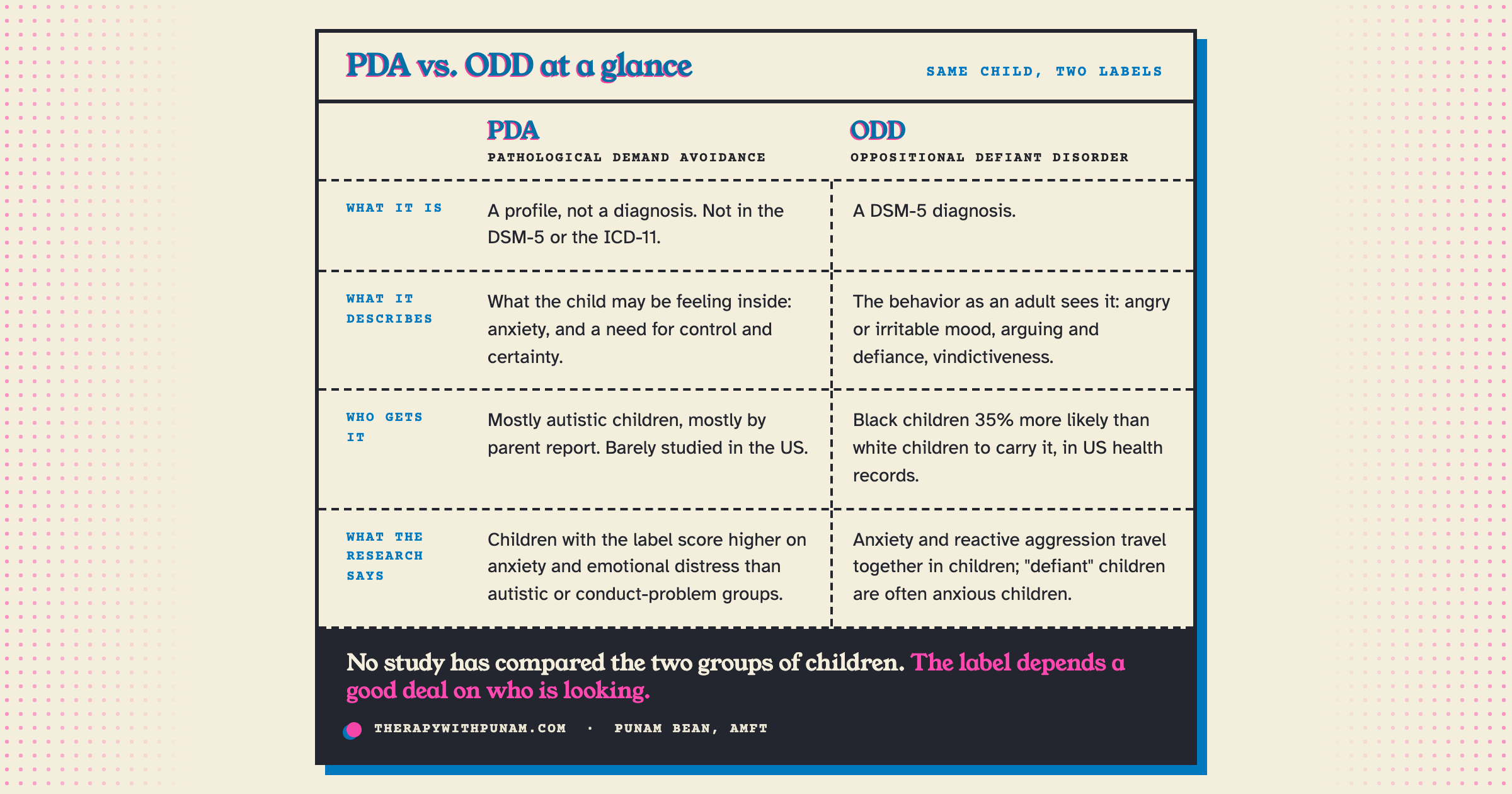
    PDA vs. ODD at a glance
    Same child, two labels
    PDA Pathological demand avoidance
    ODD Oppositional defiant disorder
    What it is
    A profile, not a diagnosis. Not in the DSM-5 or the ICD-11.
    A DSM-5 diagnosis.
    What it describes
    What the child may be feeling inside: anxiety, and a need for control and certainty.
    The behavior as an adult sees it: angry or irritable mood, arguing and defiance, vindictiveness.
    Who gets it
    Mostly autistic children, mostly by parent report. Barely studied in the US.
    Black children 35% more likely than white children to carry it, in US health records.
    What the research says
    Children with the label score higher on anxiety and emotional distress than autistic or conduct-problem groups.
    Anxiety and reactive aggression travel together in children; “defiant” children are often anxious children.
    No study has compared the two groups of children. The label depends a good deal on who is looking.
    therapywithpunam.com  ·  Punam Bean, AMFT

    Sources in the reference list: Green 2018 · Kildahl 2021 · Stuart 2020 · O’Nions 2014b · Bubier & Drabick 2009 · Shalaby 2024 · APA 2013

    Anxiety or defiance? The line is blurred.

    At the pediatrician’s office, Dana said, “I’ve heard of this thing called PDA. Could what my child is experiencing be that?” The doctor hadn’t heard much about PDA, only that it was associated with autism, and her child was not autistic. Dana told the doctor it seemed like there was a panic or anxiety driving the behaviors. She recalled the time her daughter was supposed to go to a peer’s birthday party. Her daughter had a meltdown about going, and then, when Dana decided to stay home, had another meltdown about missing the party. She was so anxious about Monday, when everyone at school would be talking about it, that she refused to go.

    Dana heard a child who could not go, and the doctor heard a child who would not. Clinical guides such as Attwood and Garnett’s draw the same line, describing ODD as driven by defiance and PDA as driven by anxiety (Attwood et al., 2024). But PDA looks like defiance, and defiance, aggression, spite, and vindictiveness from a child who holds almost no power can also be driven by anxiety.

    Research has shown that anxiety symptoms and reactive aggression are consistently related in children (Bubier & Drabick, 2009). In a small British study, parents rated children with the PDA label as having antisocial traits that approached those of a conduct-problems group. Those same children scored higher on anxiety and emotional distress than either the autism group or the conduct group (O’Nions et al., 2014b).

    The doctor and Dana were describing the same child, and nothing in the behavior told them which label was right. There is no study that has compared children diagnosed with ODD to children identified with PDA directly (Kildahl et al., 2021). No study has shown whether anxiety drives the avoidance, or follows after a period of perceived loss of autonomy. Until research explores this question, the tools we have for distinguishing are the two inadequate.

    In records from about fifty US health systems over ten years, Black patients were 35% more likely than white patients to carry an ODD diagnosis and 61% more likely to carry conduct disorder, and 26% less likely to have ADHD diagnosed at all (Shalaby et al., 2024). Research is not untouched by bias. ODD as a diagnosis has existed in the DSM since the 1980s (Ghosh et al., 2017), and never since then has never explored the child’s own account of their behavior outside of questionnaires and measures.

    Dana heard a child who could not go, and the doctor heard a child who would not.

    Is it PDA or ODD? How to tell

    I start by believing the parent. A PDA questionnaire exists (the Extreme Demand Avoidance Questionnaire), but no one has shown that it can separate PDA from ODD (O’Nions et al., 2014a). If you found this page, you may have come here to find the lightbulb moment many parents describe when they learn about PDA (Curtis & Izett, 2025).

    When I’m in the room, I ask if the parent suspects that their child might be neurodivergent. Then I see if what looks like “trying to be defiant” can make sense through an anxiety lens. A child struggling with shoes might be overwhelmed by being told what to do all day at school. There may be sensory issues or trouble with planning and starting tasks behind the behavior (Ben-Sasson et al., 2009; Demetriou et al., 2018). Interestingly, since the first observation of the behaviors we now call PDA were made (Newson et al., 2003), it’s been found that children (and potentially, adults) who exhibit PDA behaviors can retreat into role playing or fantasy, as a coping mechanism or escape (Stuart et al., 2020; Johnson & Saunderson, 2023). In clinical practice when expressed in play it tends to be rigid and scripted – “you say this, I’ll say that.” (O’Nions et al., 2016, 2018). In practice, I’ve also seen this behavior as a lens through which to understand and interpret the world.

    When it lands like that, it’s the beginning of a journey rather than an answer. One study showed that out of 112 autistic children, seven in ten also met criteria for another condition, often social anxiety or ADHD (Simonoff et al., 2008). I find that parents have already adapted in meaningful ways to support their child (Curtis & Izett, 2025). I look at what’s going well and what attachment between caregiver and child looks like.

    Real-life examples of demand avoidance

    Dana can’t understand why it’s so hard. Her daughter loves her swim class, her friends, and her swim teacher. When she’s in the pool she seems so happy, but when it’s time to get ready and go, she collapses on the threshold of the front door. She’s wearing her swimsuit under her clothes with her cap already on, face down and screaming that the cap is pulling her hair. She’s screaming that her mom put it on wrong and that she just wants to rip it off! She hates swimming! She hates the cap! She hates everything! Dana tries to comfort her, but she just screams when Dana comes near.

    A year ago, Dana would have lost it and said something like, okay, well, if you hate it then you don’t need to go to swim class anymore! She still feels it rising up inside of her, but she tells that part of her to take a seat. She tries to see it from her daughter’s point of view. That cap must be so tight. And she had a fight with a friend at school this morning. And Dana admittedly couldn’t find the cap she usually uses today. Her compassion is sitting in tension with the prospect of another missed swim class.

    Dana’s daughter loves her swim class. She didn’t want to miss it. She just couldn’t go. There is nothing to gain from defiance when it gets in the way of the things you love (O’Nions et al., 2018). That’s anxiety, and for parents, living with it can feel like vigilance and isolation. Not many people can understand why Dana’s daughter was dressed and ready and at the door and still couldn’t make it to the pool. As a PDA parent, I’ve been there. As a therapist, it’s given me the tools to help other parents find their own version of that doorway.

    So I just let them get away with it?

    Getting away with it is the language of the systems the demands came from, not the language of the child. To lower demands means to reevaluate everything you ever assumed about parenthood, about your children, and about life. It means you are actively having to work against the systems within which you live. As a PDA parent myself, nothing has been more radicalizing than lowering demands and standing as an advocate between my family and the systems that want us to show up every day, be on time, be ready to work.

    Part of my ability to accommodate them is my own privilege of having a job where I control my schedule. Sometimes it’s not possible, and the further you are from that kind of privilege, the harder this is. Sometimes I have to look within myself and get curious about why it’s important to me that they put their own shoes on. Honestly, we just take them to the car and they put them on during the drive, or I pop them on while they’re still buckled in if I can.

    Getting away with it is the language of the systems the demands came from, not the language of the child.

    Where parents can start

    Dana breathes through it and sits down a few feet away on the front porch from where her daughter is lying. She uses her body to show that it’s okay and they don’t have to rush. Then she says, “Wow, you have had such a tough day today and I put your cap on wrong. Of course you’re upset.” Her daughter stops crying for a moment to look up. Then she starts to cry in agreement. Dana is mindful about releasing the tension in her body. They don’t make it to swim class that day, but the situation doesn’t escalate, and that is a win for them both.

    Dana is co-regulating, lending her daughter her calm until she can find her own (Curtis & Izett, 2025). Her daughter’s nervous system still needs her mother’s to find its way back to calm.

    We as parents know that we will love our children no matter what they do. But do they know that? Sometimes we are irritated or anxious, we’re tired, it’s been a long day or a long meltdown, and they interpret our irritation and frustration as a demand to do better (O’Nions et al., 2018). Sometimes it feels like no matter how hard you try, they can’t seem to absorb your love.

    I’ve been there, and I’ve charted a path through to a place where I feel more equipped when a child is thrashing on the floor. I can let go of the reason why they’re thrashing and see the child in pain. I can say, I’m here, I can get some water, I can triage without expectation. More times than not. That’s the best any of us can do.

    If you want company in that work, it’s what I do with parents: helping your own nervous system learn to hold the immensity of feeling our children have.

    Sound familiar? Book a free 15-min consult

    Dana is a composite of many parents I’ve worked with. No detail here belongs to one family.

    Punam Bean

    About the author

    Punam Bean, MS, AMFT is a neurodivergent, PDA-informed therapist in Los Angeles, online across California, and a parent of PDA children. She works with PDA children, teens and adults and their parents, late-identified autistic and ADHD adults, and neurodivergent couples.

    Associate Marriage and Family Therapist · CA registration #153488 · supervised by Marni Glick, LMFT (CA #117104)

    References & further reading (17)

    Each entry says what it’s for, so you can tell whether it’s worth your click.

    American Psychiatric Association. (2013). Diagnostic and statistical manual of mental disorders (5th ed.). read →The official definition of ODD that clinicians use. Worth a look if your child has been given this diagnosis and you want to see exactly what it requires.

    Attwood, T., Hinze, E., & Garnett, M. (2024, July 9). Differentiating pathological demand avoidance in autism from oppositional defiant disorder. Attwood & Garnett Events. read →A clinician’s guide to the standard anxiety-versus-defiance distinction, with “I can’t, not I won’t” as its center. Useful for seeing how most professionals frame the difference, which is the framing this article questions.

    Ben-Sasson, A., et al. (2009). A meta-analysis of sensory modulation symptoms in individuals with autism spectrum disorders. Journal of Autism and Developmental Disorders, 39(1), 1–11. read →Fourteen studies showing that autistic children take in sound, touch, and texture differently from other children. For the parent who suspects the sock seam or the swim cap really is the whole story.

    Bubier, J. L., & Drabick, D. A. G. (2009). Co-occurring anxiety and disruptive behavior disorders: The roles of anxious symptoms, reactive aggression, and shared risk processes. Clinical Psychology Review, 29(7), 658–669. read →A review of why anxious children and “defiant” children are so often the same children. The research behind the idea that anxiety can come out looking like aggression. Free to read.

    Curtis, S. J., & Izett, E. (2025). The experience of mothers of autistic children with a pathological demand avoidance profile: An interpretative phenomenological analysis. Discover Mental Health, 5(1). read →Ten mothers describe what PDA did to their families, the “light-bulb moment” of learning the word, and how giving their child more control helped. If you want to hear from parents who have been where you are, start here. Free to read.

    Demetriou, E. A., et al. (2018). Autism spectrum disorders: A meta-analysis of executive function. Molecular Psychiatry, 23(5), 1198–1204. read →Two hundred thirty-five studies on planning, starting, and switching tasks in autistic people. Relevant if “just put your shoes on” never seems to be simple for your child.

    Green, J., Absoud, M., Grahame, V., Malik, O., Simonoff, E., Le Couteur, A., & Baird, G. (2018). Pathological demand avoidance: Symptoms but not a syndrome. The Lancet Child & Adolescent Health, 2(6), 455–464. read →The main scientific case against PDA as a separate condition. Read it if a clinician has told you PDA “isn’t recognized” and you want to understand the argument they’re standing on.

    Johnson, M., & Saunderson, H. (2023). Examining the relationship between anxiety and pathological demand avoidance in adults: A mixed methods approach. Frontiers in Education, 8, 1179015. read →One hundred sixty-three adults, thirteen interviewed. Anxiety and trouble with uncertainty still drive the avoidance in adulthood. For the parent reading about their child and recognizing themselves. Free to read.

    Kildahl, A. N., Helverschou, S. B., Rysstad, A. L., Wigaard, E., Hellerud, J. M., Ludvigsen, L. B., & Howlin, P. (2021). Pathological demand avoidance in children and adolescents: A systematic review. Autism, 25(8), 2162–2176. read →Reviews every PDA study published to 2021: thirteen in total, mostly autistic children, mostly parent report, and no study following children over time. The honest state of the evidence, in one place. Free to read.

    Newson, E., Le Maréchal, K., & David, C. (2003). Pathological demand avoidance syndrome: A necessary distinction within the pervasive developmental disorders. Archives of Disease in Childhood, 88(7), 595–600. read →The paper that named PDA, from the psychologist who first described these children in the 1980s. Where the whole conversation started, and still the clearest description of what parents see.

    O’Nions, E., Christie, P., Gould, J., Viding, E., & Happé, F. (2014a). Development of the ‘Extreme Demand Avoidance Questionnaire’ (EDA-Q): Preliminary observations on a trait measure for pathological demand avoidance. Journal of Child Psychology and Psychiatry, 55(7), 758–768. read →The questionnaire used to screen for PDA traits, and its authors’ own caution that it hasn’t been shown to separate PDA from other behavior problems.

    O’Nions, E., Viding, E., Greven, C. U., Ronald, A., & Happé, F. (2014b). Pathological demand avoidance: Exploring the behavioural profile. Autism, 18(5), 538–544. read →The first study to compare PDA children with autistic children and children with conduct problems. The PDA children looked nearly as antisocial as the conduct group and were the most anxious of all three. Free to read.

    O’Nions, E., Gould, J., Christie, P., Gillberg, C., Viding, E., & Happé, F. (2016). Identifying features of ‘pathological demand avoidance’ using the Diagnostic Interview for Social and Communication Disorders (DISCO). European Child & Adolescent Psychiatry, 25(4), 407–419. read →Clinic records of 153 children assessed for autism, with the PDA features pulled out. Includes the finding that these children’s pretend play was mostly rigid and controlled rather than free. Free to read.

    O’Nions, E., Viding, E., Floyd, C., Quinlan, E., Pidgeon, C., Gould, J., & Happé, F. (2018). Dimensions of difficulty in children reported to have an autism spectrum diagnosis and features of extreme/’pathological’ demand avoidance. Child and Adolescent Mental Health, 23(3), 220–227. read →Parents of 26 PDA children describe what the avoidance looks like at home, including children making it impossible for themselves to do things they wanted to do. Likely to feel very familiar. Free to read.

    Shalaby, N., Sengupta, S., & Williams, J. B. (2024). Large-scale analysis reveals racial disparities in the prevalence of ADHD and conduct disorders. Scientific Reports, 14. read →Records from about fifty US health systems over ten years. Black patients were 35% more likely to carry an ODD diagnosis and 61% more likely to carry conduct disorder, and 26% less likely to have ADHD diagnosed. Relevant if you are wondering who gets which label.

    Simonoff, E., Pickles, A., Charman, T., Chandler, S., Loucas, T., & Baird, G. (2008). Psychiatric disorders in children with autism spectrum disorders: Prevalence, comorbidity, and associated factors in a population-derived sample. Journal of the American Academy of Child & Adolescent Psychiatry, 47(8), 921–929. read →One hundred twelve autistic children aged 10 to 14; seven in ten met criteria for at least one other condition, most often social anxiety, ADHD, or ODD. Relevant if your child has more than one diagnosis, or you suspect they should.

    Stuart, L., Grahame, V., Honey, E., & Freeston, M. (2020). Intolerance of uncertainty and anxiety as explanatory frameworks for extreme demand avoidance in children and adolescents. Child and Adolescent Mental Health, 25(2), 59–67. read →Two hundred fourteen families; the children’s need for certainty predicted their demand avoidance, and anxiety explained the meltdowns. The study behind “the avoidance is about control and uncertainty, not defiance.”